
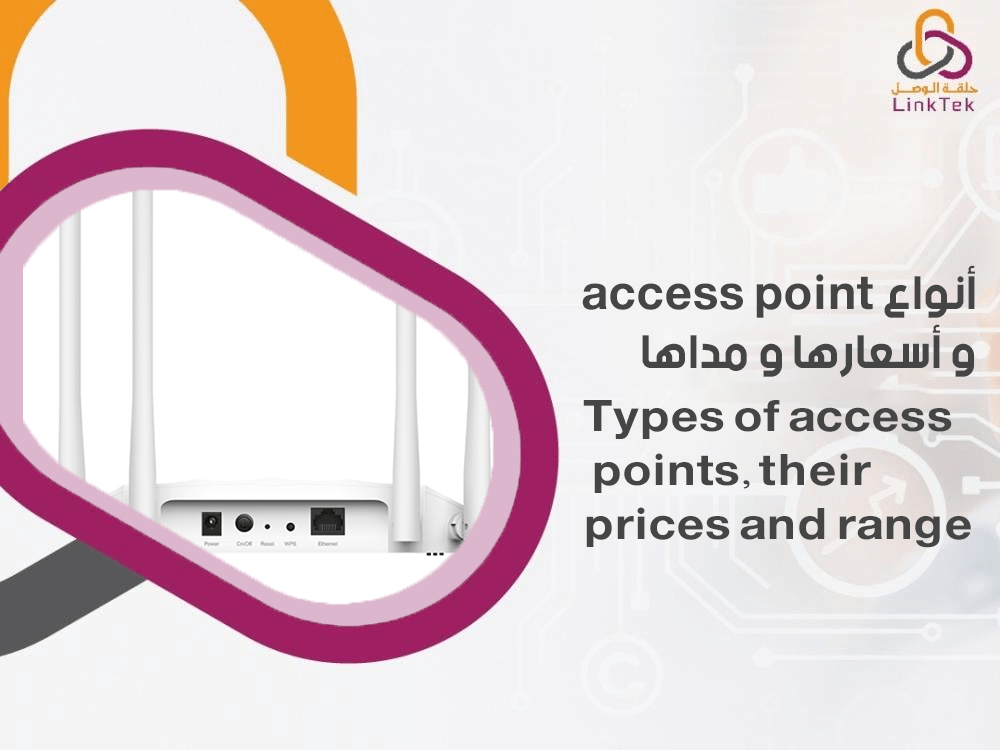

The recent trend nowadays is the presence of strong internet connection in different places, either commercial places, banks, schools, or even homes as it is so important to facilitate different works. This emphasizes the presence of the access points that work as a bridge between wired and wireless networks to connect different devices to the internet through wireless connection. So what are the access point types, prices and ranges? That's what we are going to know in this article.
What are the access point types, prices and ranges?
First of all you need to know the definition of the excess point as the access point in the network device that can connect to the router through wires to make a wireless network that will connect wirelessly to other devices in the surrounding area, like laptops, mobile phones and other devices. As we mentioned before, an access point can work as a bridge between wireless and wire the network.
Access points can be divided into different types according to their performance, their management type, connection type and method of getting energy. Generally, access points can be divided into the following:
- Standalone access points: which are characterized by their limited performance and Limited area coverage, as it can serve a number that does not exceed 50 users. Management of this type of access points is so easy, as it depends on simple management techniques. Defining the price of this type of access points depends on the presence of other recent techniques like the type of supported Wi-Fi and energy obtaining methods.
- Controller based access point: that is characterized by high performance and its ability to support a huge number of customers. This type is also characterized by its central distance management as well. When it comes to price, This type of access point is expensive due to the presence of cloud management features, as the price is controlled by the presence of other advanced features as well, but generally its price ranges between 500 to 3,000 Saudi riyals according to its available features.
- Router access points: this type of access points is the most common type. It is characterized by its average performance. This type fits middle and small networks.
- Mesh access point: this type of access points give the ability to different devices to work within the network system of the place to enlarge the wireless network coverage. This type of access points can give high performance and high stability to the network.
- Outdoor access points, this type of access points are designed to work in outdoor places as it provides high performance and high coverage to wide places.
- PoE access points, as this type of access point is designed to get energy through the Ethernet cable and to be used in places where electricity cable is not available.
Finally the range of the excess point is dependent on the supported frequency as an access point that supports a frequency of 5 Mhz can give a higher range in comparison with 2.4 frequency. The range of the access point is also dependent on the presence of air antennas as the presence of them can increase the range of the access point. Finally the range of the excess point can be decreased due to the presence of electromagnetic signals interference.
Factors affecting price and the performance of the access points
Performance and price of the access points is controlled by a lot of factors, example of these factors are as follows:
- The supported Wi-Fi techniques, as access points can support different Wi-Fi techniques starting from Wi-Fi 4 as the least Wi-Fi technique, the least performance and consequently the least price, while Wi-Fi 6 and Wi-Fi 6E is the highest performance which can support higher speeds and consequently higher prices.
- Supported frequency ranges, as supporting dual frequency or triple frequency can give the access point a higher performance and consequently a higher price in comparison to supporting a single frequency. Most access points support a frequency of 5 and 2.4 Mhz, while some axis points can support an additional frequency of 6 Mhz.
- Management of the network, as the managed access point is more expensive than the unmanaged access point.
- The number of concurrent users that the device can support, as increasing the number of concurrent users increases the price of the Access Point device and vice versa.
- The ability of the device to work in closed or open environments, as access points that can work in open environments need higher range coverage, which requires advanced antennas and advanced technologies, as well as protection factors from harsh environmental conditions.
- Energy obtaining the method as devices that can get power from the Ethernet cables are more expensive than access points that can get energy only through electricity cables.
- Supporting advanced security features, as the support of advanced security features can elevate the performance of the access point and consequently elevate the price.

Access point types prices and the ranges differ according to their supported features and the range of the presence of Advanced technological features. It depends on the ability of the device to work in different environmental conditions and its ability to support the highest number of users as well.